Pediatric Assessment Triangle
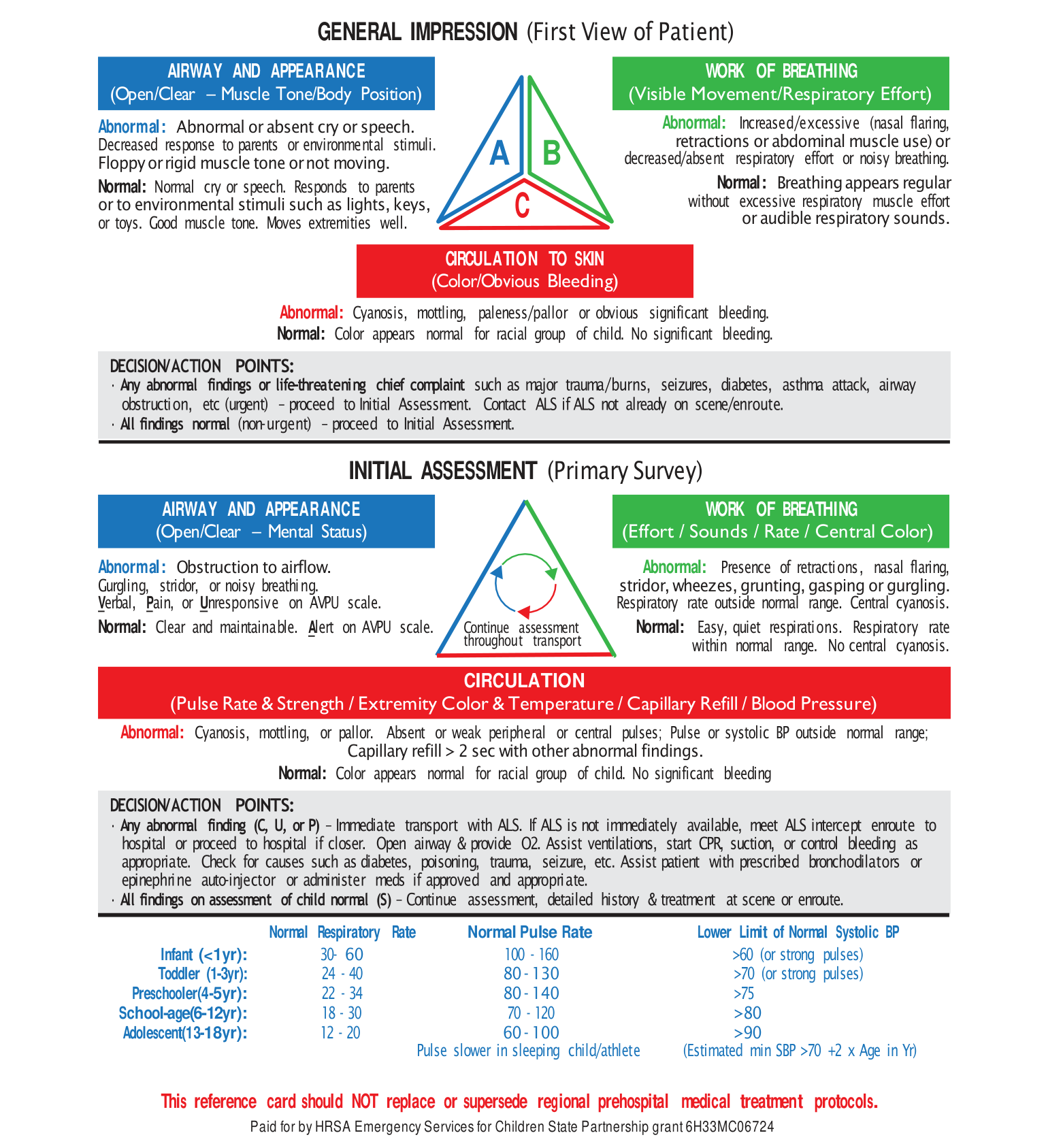
  • AIRWAY AND APPEARANCE Open/Clear – Muscle Tone/Body Position AIRWAY AND APPEARANCE (Open/Clear – Mental Status) WORK OF BREATHING (Effort / Sounds / Rate / Central Color) GENERAL IMPRESSION (First View of Patient) Abnormal: Abnormal or absent cry or speech. Decreased response to parents or environmental stimuli. Floppy or rigid muscle tone or not moving. Normal: Normal cry or speech. Responds to parents or to environmental stimuli such as lights, keys, or toys. Good muscle tone. Moves extremities well. Abnormal: Increased/excessive (nasal flaring, retractions or abdominal muscle use) or decreased/absent respiratory effort or noisy breathing. Normal: Breathing appears regular without excessive respiratory muscle effort or audible respiratory sounds. Abnormal: Cyanosis, mottling, paleness/pallor or obvious significant bleeding. Normal: Color appears normal for racial group of child. No significant bleeding. INITIAL ASSESSMENT (Primary Survey) Abnormal: Obstruction to airflow. Gurgling, stridor, or noisy breathing. Verbal, Pain, or Unresponsive on AVPU scale. Normal: Clear and maintainable. Alert on AVPU scale. Continue assessment throughout transport Abnormal: Presence of retractions, nasal flaring, stridor, wheezes, grunting, gasping or gurgling. Respiratory rate outside normal range. Central cyanosis. Normal: Easy, quiet respirations. Respiratory rate within normal range. No central cyanosis. Abnormal: Cyanosis, mottling, or pallor. Absent or weak peripheral or central pulses; Pulse or systolic BP outside normal range; Capillary refill > 2 sec with other abnormal findings. Normal: Color appears normal for racial group of child. No significant bleeding Normal Respiratory Rate Normal Pulse Rate Lower Limit of Normal Systolic BP Infant (<1yr): 30- 60 100 - 160 >60 (or strong pulses) Toddler (1-3yr): 24 - 40 80 - 130 >70 (or strong pulses) Preschooler(4-5yr): 22 - 34 80 - 140 >75 School-age(6-12yr): 18 - 30 70 - 120 >80 Adolescent(13-18yr): 12 - 20 60 - 100 >90 Pulse slower in sleeping child/athlete (Estimated min SBP >70 +2 x Age in Yr) AIRWAY AND APPEARANCE (Open/Clear – Muscle Tone/Body Position) WORK OF BREATHING (Visible Movement/Respiratory Effort) CIRCULATION TO SKIN (Color/Obvious Bleeding) CIRCULATION (Pulse Rate & Strength / Extremity Color & Temperature / Capillary Refill / Blood Pressure) A B C This reference card should NOT replace or supersede regional prehospital medical treatment protocols. Paid for by HRSA Emergency Services for Children State Partnership grant 6H33MC06724
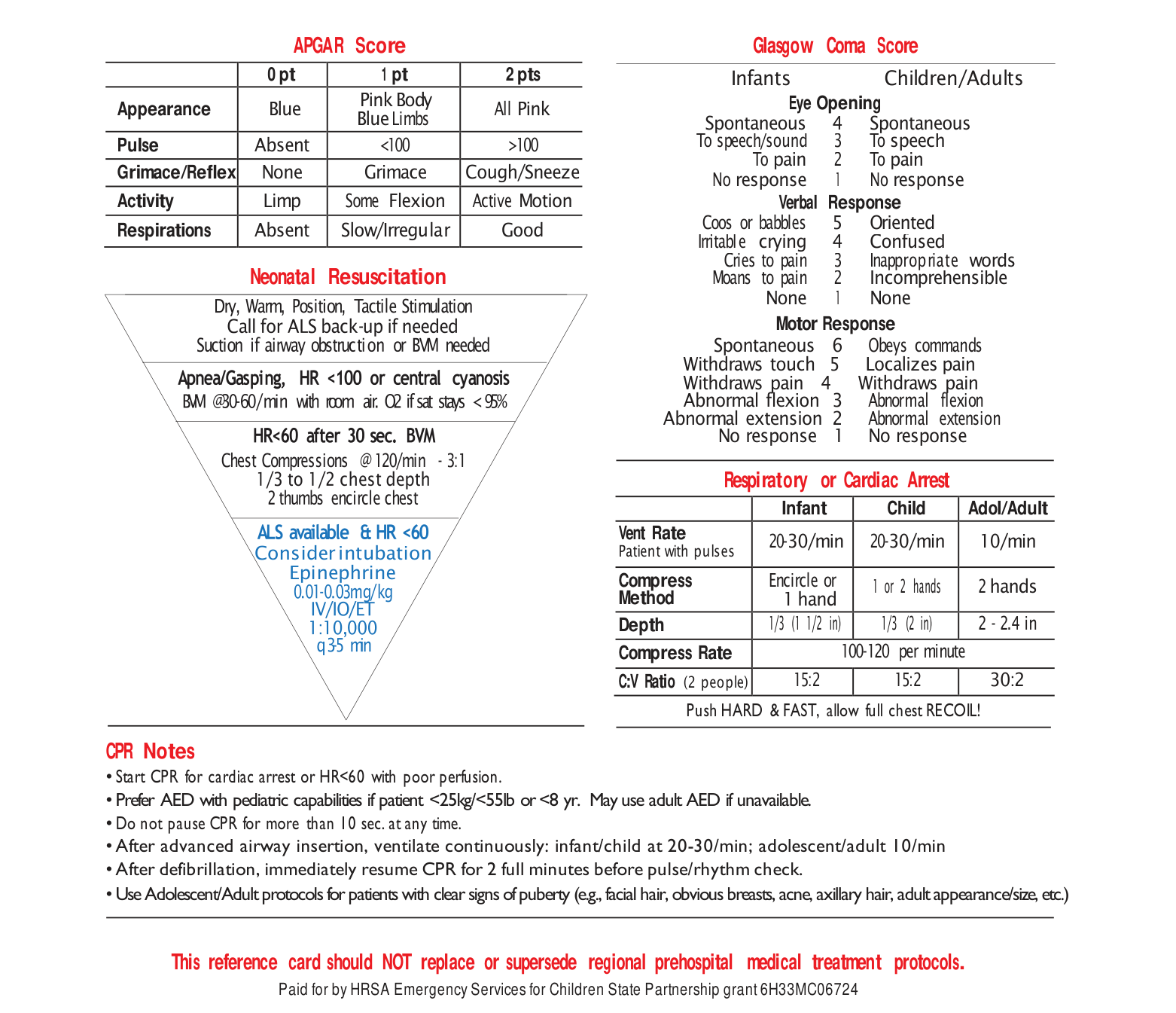
  • This reference card should NOT replace or supersede regional prehospital medical treatment protocols. Paid for by HRSA Emergency Services for Children State Partnership grant 6H33MC06724 APGAR Score 0 pt 1 pt 2 pts Appearance Blue Pink Body Blue Limbs All Pink Pulse Absent <100 >100 Grimace/Reflex None Grimace Cough/Sneeze Activity Limp Some Flexion Active Motion Respirations Absent Slow/Irregular Good Neonatal Resuscitation CPR Notes • Start CPR for cardiac arrest or HR<60 with poor perfusion. Glasgow Coma Score Infants Children/Adults Eye Opening Spontaneous 4 Spontaneous To speech/sound 3 To speech To pain 2 To pain No response 1 No response Verbal Response Coos or babbles 5 Oriented Irritable crying 4 Confused Cries to pain 3 Inappropriate words Moans to pain 2 Incomprehensible None 1 None Motor Response Spontaneous 6 Obeys commands Withdraws touch 5 Localizes pain Withdraws pain 4 Withdraws pain Abnormal flexion 3 Abnormal flexion Abnormal extension 2 Abnormal extension No response 1 No response Respiratory or Cardiac Arrest Infant Child Adol/Adult Vent Rate Patient with pulses 20-30/min 20-30/min 10/min Compress Method Encircle or 1 hand 1 or 2 hands 2 hands Depth 1/3 (1 1/2 in) 1/3 (2 in) 2 - 2.4 in Compress Rate 100-120 per minute C:V Ratio (2 people) 15:2 15:2 30:2 Push HARD & FAST, allow full chest RECOIL! • Prefer AED with pediatric capabilities if patient <25kg/<55lb or <8 yr. May use adult AED if unavailable. • Do not pause CPR for more than 10 sec. at any time. • After advanced airway insertion, ventilate continuously: infant/child at 20-30/min; adolescent/adult 10/min • After defibrillation, immediately resume CPR for 2 full minutes before pulse/rhythm check. • Use Adolescent/Adult protocols for patients with clear signs of puberty (e.g., facial hair, obvious breasts, acne, axillary hair, adult appearance/size, etc.) Consider intubation Epinephrine